 blog
Commercial Drywall Services in Sacramento: 2026 Guide
Table of Contents
- Commercial Drywall Services in Sacramento: What Your Project Needs
- Commercial vs. Residential Drywall: Key Differences
- Commercial Drywall Installation Best Practices
- Commercial Drywall Cost Per Square Foot in Sacramento
- Drywall Repair Services for Commercial Spaces
- Commercial Building Codes, Fire-Rated Drywall, and Sustainability
- How to Choose a Commercial Drywall Contractor in Sacramento
- Conclusion: Getting Your Commercial Drywall Project Right
- Frequently Asked Questions
Last Updated: October 4, 2026
Commercial Drywall Services in Sacramento: What Your Project Needs
Commercial drywall services in Sacramento cover the installation, finishing, and repair of interior wall and ceiling systems in offices, retail spaces, restaurants, warehouses, and multi-family buildings.
This guide breaks down what a commercial project actually requires: how the work differs from residential drywall, how installation should be sequenced, what drives cost per square foot, and which building code requirements apply to fire-rated and moisture-resistant assemblies.
Commercial vs. Residential Drywall: Key Differences
Commercial drywall is specified by performance, not by appearance alone. A residential job is usually judged on how the wall looks when it is painted. A commercial job is judged on whether the assembly meets its fire-resistance rating, sound transmission class, and structural requirements, then passes inspection.
The practical differences show up in four places:
- Board type and thickness. Commercial assemblies often call for fire-rated Type X gypsum board, moisture-resistant board in wet areas, or abuse-resistant board in corridors and service halls.
- Framing and backing. Commercial walls carry more blocking for handrails, casework, signage, and wall-mounted equipment.
- Finishing level. Most commercial spaces specify a higher drywall finishing level because flat paint and harsh lighting expose every ridge and joint.
A common mistake is treating a tenant improvement like a large residential repair. The labor looks similar. The liability does not.
Commercial Drywall Installation Best Practices
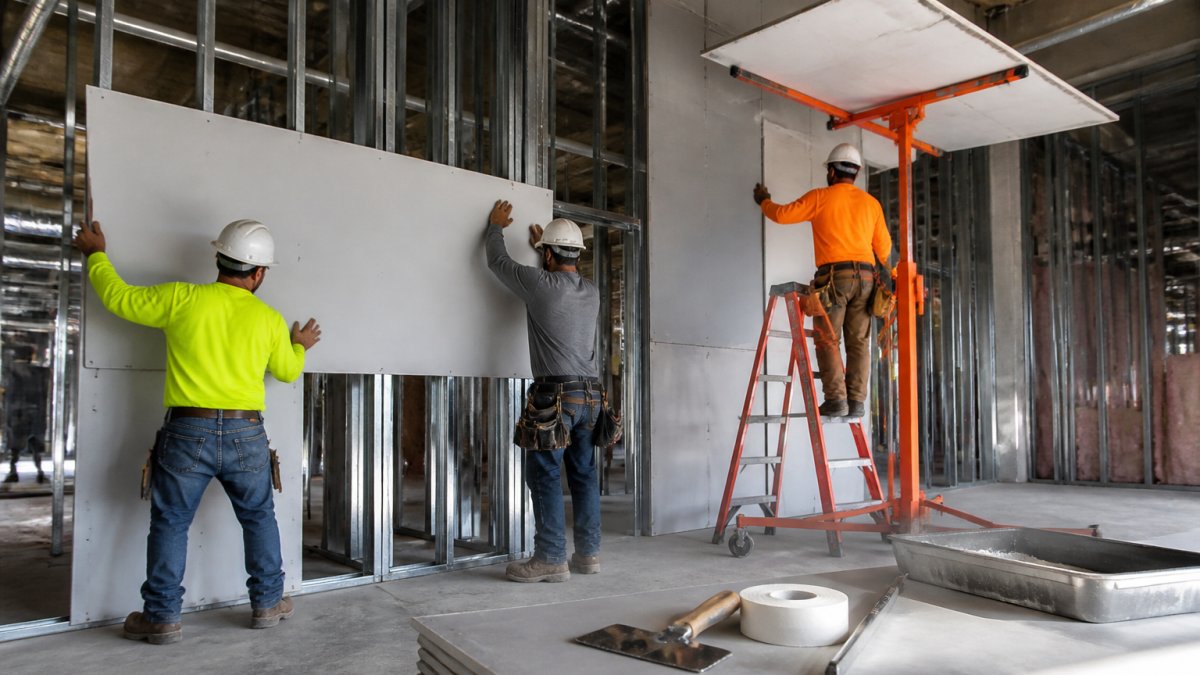
Commercial drywall installation follows a fixed sequence: verify the framing, hang the board, tape and mud the joints, then finish to the specified level.
Surface Preparation and Framing Checks
Before a single sheet goes up, the framing has to be right. We check stud spacing, plumb, and straightness, confirm blocking is installed where fixtures and casework will hang, and verify that electrical and plumbing rough-ins are complete and inspected. Board screwed to a twisted stud will telegraph through the finish no matter how well it is taped. This step is where commercial jobs are won or lost.
Hanging, Taping, and Finishing Levels
Hanging follows the framing check: boards are oriented correctly, fastened at the specified spacing, and staggered so joints do not line up in a continuous seam. Taping and mudding come next, and the number of coats depends on the drywall finishing level written into the plans. A level 4 finish suits most painted commercial walls. Level 5, which adds a skim coat over the entire surface, is what you specify when flat paint, gloss, or strong directional lighting will expose the substrate.
Commercial Drywall Cost Per Square Foot in Sacramento
Commercial drywall cost per square foot depends on board type, ceiling height, finishing level, and site conditions, not on a single flat rate. Two projects with the same square footage can land far apart once you factor in fire-rated assemblies, scaffolding, and after-hours work. The most useful way to estimate a commercial project is to build the number from four inputs: material cost per sheet, labor hours per square foot, finishing level multiplier, and site-condition adders.
How the Number Is Built
A commercial drywall estimate starts with the board schedule from the plans. Each assembly type, standard partition, fire-rated corridor wall, shaft wall, ceiling, gets priced separately because each has a different material cost and labor factor. From there, the estimator applies:
- Material cost per sheet. Standard 1/2-inch gypsum board, 5/8-inch Type X fire-rated board, moisture-resistant (MR) board, and abuse-resistant board each carry different per-sheet costs, and specialty board also takes longer to handle and cut.
- Labor hours per square foot. Hanging, taping, and finishing are tracked separately. A level 4 finish typically takes fewer coats and less sanding time than a level 5 skim coat, and the labor difference is the single biggest swing in most estimates.
- Finishing level multiplier. Level 3, 4, and 5 each add coats, drying time, and sanding labor. Level 5 adds a full-surface skim coat, which is a meaningful labor and material line item, not a rounding error.
- Site-condition adders. Occupied buildings, after-hours work, dust containment, and demolition of existing board all add labor and supervision hours that a new-build shell does not carry.
What Moves the Number Most
| Cost Driver | What Changes It | Why It Matters |
|---|---|---|
| Board type | Standard vs. fire-rated, moisture-resistant, or abuse-resistant | Specialty board costs more per sheet and takes longer to install |
| Ceiling height | Standard height vs. work above lift reach | Taller walls need lifts or scaffolding and more labor hours |
| Finishing level | Level 3, 4, or 5 | Each level adds coats, sanding, and drying time |
| Site access | Open shell vs. occupied building | Occupied spaces need protection, dust control, and off-hours scheduling |
| Demolition and prep | New build vs. tear-out | Removal, disposal, and substrate repair add scope |
| Assembly complexity | Single-layer vs. multi-layer rated assemblies | More layers mean more fasteners, more joints, and more inspection points |
Why We Quote After a Site Visit
Because pricing depends on quantity, height, finish level, and assembly type, we quote commercial work after an on-site assessment rather than from a phone estimate. A phone number based on square footage alone will be wrong on any project with fire-rated corridors, multi-layer demising walls, or occupied-space phasing. During the walkthrough we measure the actual wall and ceiling areas, confirm the assembly types called out on the plans, note access and phasing constraints, and identify any demolition or substrate repair that is not visible on paper.
Drywall Repair Services for Commercial Spaces
Drywall repair services for commercial buildings cover water damage, impact damage, tenant turnover patches, and texture matching. The goal is a repair that disappears into the existing wall, not one that reads as a patch.
Texture matching is where most repair work fails. A ceiling with a sprayed or hand-applied texture cannot be blended with a flat patch, so the repair has to replicate the original pattern and sheen.
Commercial Building Codes, Fire-Rated Drywall, and Sustainability
Fire-rated drywall and building code compliance are where commercial work separates from residential. Assemblies in corridors, stairwells, mechanical rooms, and between tenant spaces are often required to carry a fire-resistance rating, and that rating depends on the exact combination of board type, thickness, fastener schedule, and joint treatment listed by the manufacturer. This is the part of the project most likely to fail inspection, and it is the part most generic drywall content skips.
How a Fire Rating Actually Works
A fire-resistance rating is not a property of the board, it is a property of the assembly.
The ratings themselves come from standardized fire tests, and the resulting assemblies are published in listing directories that inspectors and plans examiners reference. On a commercial job, the plans should call out the specific assembly designation, and the installed wall has to match it exactly.
Sound Ratings and Demising Walls
Sound transmission is a separate requirement from fire rating, and the two are often confused. A sound transmission class (STC) rating describes how well an assembly blocks airborne sound, and party walls and demising walls between tenant spaces frequently carry a specified STC target. STC is affected by framing, insulation, the number of board layers, and whether the assembly uses resilient channels or staggered studs.
Sustainability and Green Building Documentation
More commercial clients now ask for gypsum board with recycled content and low-emitting materials, and on projects pursuing green building certification, material selection has to be documented before the board is ordered, not after. Programs like LEED certification requirements reward projects that document recycled content, regional materials, and low-emitting adhesives, sealants, and finishes. The practical implication for a drywall scope is that the submittal package needs to include manufacturer documentation for the specific products installed, a generic product data sheet is not enough if the credit requires a specific recycled-content threshold or emissions certification.
Who Has the Final Say
Building codes vary by jurisdiction and by occupancy type, so the authority having jurisdiction has the final say on which edition and amendments apply. The International Code Council publishes the model codes most jurisdictions adopt, and your local building department confirms which edition and amendments apply to your project. On any commercial job, the sequence that prevents surprises is: confirm the code edition with the building department, confirm the listed assembly designations on the plans, verify the submittal documentation matches what will actually be installed, and inspect the framing and board installation before the walls are closed up.
How to Choose a Commercial Drywall Contractor in Sacramento
Choosing a commercial drywall contractor comes down to three things: verifiable experience, a clear scope, and a written schedule. Ask for the contractor's license number and check it, review comparable commercial projects, and get the finishing level and board types spelled out in the proposal.
A short checklist before you sign:
- Confirm the contractor's license is active and in good standing
- Ask for commercial references, not just residential ones
- Require the finishing level and board types in writing
- Confirm who handles permits and inspections
Site cleanup is not a minor detail. It is one of the most common complaints property owners raise about contractors, and on an occupied commercial space it affects your tenants directly.
Conclusion: Getting Your Commercial Drywall Project Right
Commercial drywall rewards planning and punishes shortcuts. The projects that go smoothly are the ones where the framing was verified, the finishing level was specified correctly, and the code requirements were settled before the first sheet went up.
The Drywall Expert brings over 20 years of experience to commercial drywall installation, repair, and texturing across the Greater Sacramento area. We provide free estimates, offer senior and military discounts, and manage each project from consultation to final cleanup.
Frequently Asked Questions
How much does commercial drywall cost per square foot?
Commercial drywall cost per square foot depends on finish level, board type, ceiling height, and site access. Fire-rated or moisture-resistant drywall and higher finishing levels add labor and material. The Drywall Expert provides free estimates based on an on-site assessment, so you get a number tied to your actual scope rather than a generic range. Request a quote for current pricing.
What should I look for when hiring a commercial drywall contractor?
Check licensing, insurance, and experience with commercial-scale projects. Ask about fire-rated drywall installation, finishing levels, and how they handle cleanup and scheduling around your business hours. Look for a contractor who provides a written scope, timeline, and warranty. The Drywall Expert has over 20 years of experience and offers free estimates for commercial projects across the Greater Sacramento area.
Do commercial drywall contractors provide fire-rated installation?
Yes. Commercial buildings require fire-rated drywall assemblies in many locations, and the specific rating depends on the assembly tested and listed for that wall or ceiling. A qualified contractor installs the correct board type, thickness, and fastening pattern to match the required rating. Ask your contractor to confirm the assembly meets the building code requirements for your space before work begins.
What is the difference between residential and commercial drywall services?
Commercial drywall services involve larger-scale projects, stricter building codes, fire-rated assemblies, and coordination with other trades on a job site. Commercial work often uses metal studs, higher finishing levels, and moisture-resistant or fire-rated board. Residential work is typically smaller in scope and less regulated. The Drywall Expert handles both, with commercial crews experienced in tenant improvements and large renovations.